


Safety Relay for Emergency Shutdown Explained
A shutdown command that arrives one second late can be the difference between a controlled stop and a plant incident. In high-risk process environments, a safety relay for emergency shutdown is not just another control component. It is a defined safety function within the protection layer that must respond predictably, fail safely, and support compliance with the required SIL target and application standard.
Plants in oil and gas, chemical processing, energy, hydrogen, marine, and other regulated sectors rarely evaluate emergency shutdown hardware on price alone. The real question is whether the relay can perform under fault conditions, integrate correctly with the logic architecture, and maintain dependable operation across the life of the system. That is where selection discipline matters.
What a safety relay for emergency shutdown actually does
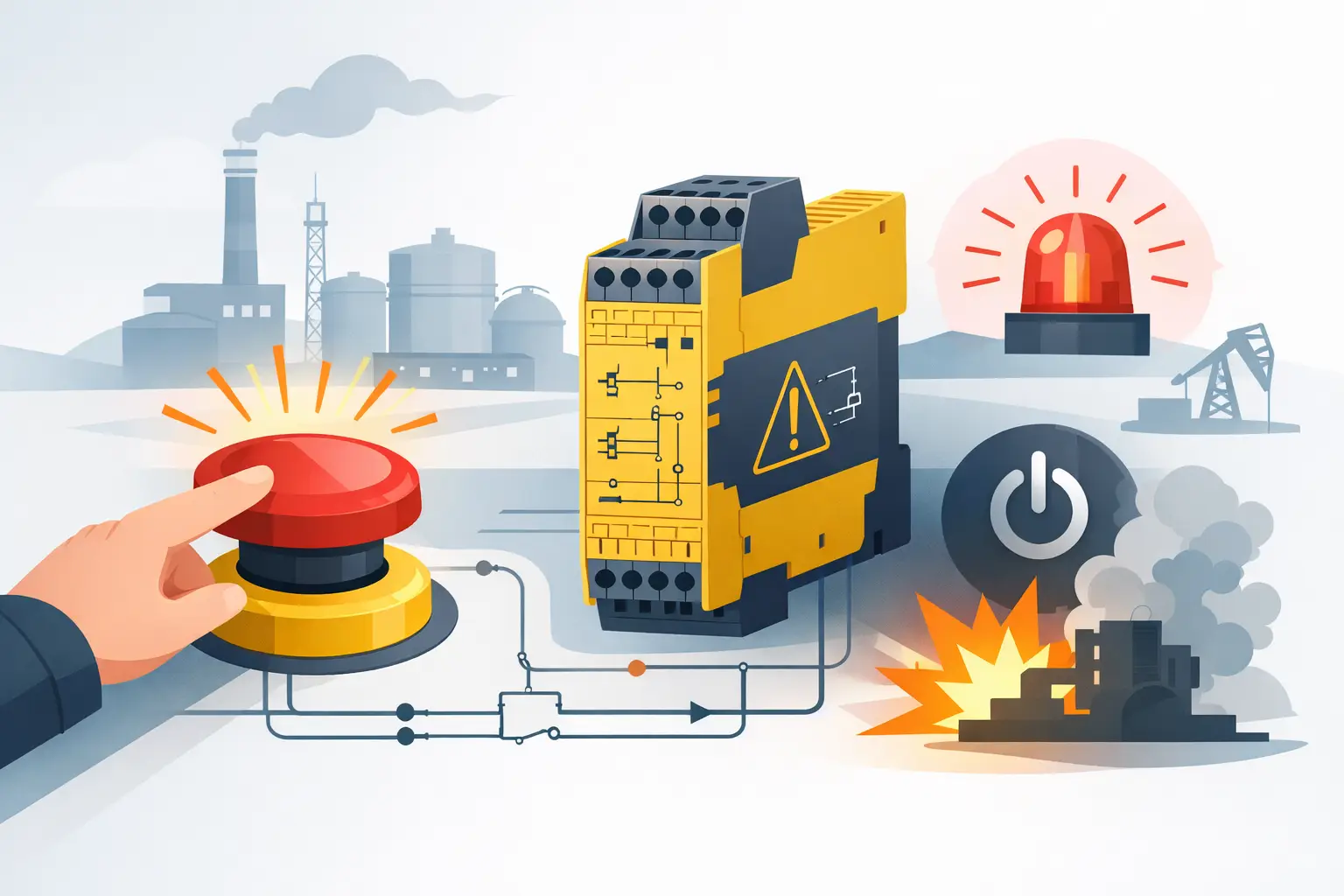
A safety relay for emergency shutdown monitors one or more safety inputs and drives outputs to place machinery or processes into a safe state when a hazardous condition is detected. That condition may come from an emergency stop pushbutton, guard switch, gas detection system, fire and gas panel, pressure trip, vibration alarm, overspeed condition, or another safety-related signal.
Unlike a standard control relay, a safety relay is designed around fault detection and defined safety behavior. It typically uses force-guided contacts, internal diagnostics, monitored reset logic, and redundancy principles to help ensure that dangerous failures are identified rather than hidden. In practice, that means the device is expected to react not only when the input changes, but also when a wiring fault, welded contact, or internal fault could compromise the shutdown path.
For emergency shutdown applications, the relay is usually part of a broader functional safety architecture. It may sit between field devices and final elements, or between the safety logic and shutdown outputs, depending on the design. In simpler packaged systems, it may provide the complete shutdown logic for a local machine. In more complex process plants, it may serve as a certified interface layer within a larger SIS or ESD arrangement.
Why standard relays are not enough for emergency shutdown
A conventional relay can energize and de-energize a circuit, but that alone does not make it suitable for risk reduction. Emergency shutdown functions require known performance under fault conditions. They also require traceability to recognized standards, documented failure data, and installation rules that support the claimed safety integrity.
This is where many projects get into trouble. A designer may see a relay with the correct coil voltage, contact rating, and enclosure format and assume it is acceptable. For a non-critical signal, that may be fine. For an emergency shutdown function, it is not. If the relay is not certified or designed for safety use, the system can end up with an undocumented weak point in the shutdown chain.
In hazardous-area applications, the evaluation becomes stricter. The shutdown signal path may also need ATEX or IECEx considerations, intrinsic safety interfaces, galvanic isolation, or installation in a certified panel design. A safety function that looks correct on a schematic can still fail a compliance review if the selected hardware does not match the zone classification, fault tolerance target, or environmental conditions.
Key selection criteria for a safety relay for emergency shutdown
The first issue is the required safety integrity. If the shutdown function is part of a SIL2 or SIL3 loop, the relay must support that claim within the overall architecture. That includes examining proof test assumptions, diagnostic coverage, dangerous failure rates, mission time, and common cause considerations. A relay does not carry the whole SIL claim by itself, but it must fit the calculation and the design intent.
The second issue is input and output architecture. Some applications need single-channel monitoring, while others require dual-channel inputs with cross-fault detection and monitored manual reset. The right choice depends on the risk assessment, not on convenience. A simple local E-stop on a standalone machine may require a different relay configuration than a shutdown interface tied to a burner management or gas release event.
Contact configuration also matters. Engineers need to confirm whether the relay provides enough safety outputs, whether auxiliary contacts are needed for status feedback, and whether the output contacts can handle the final device load directly or must drive interposing contactors. Overloading safety contacts or using them outside their tested application category is a common design mistake.
Environmental suitability should be treated as a performance issue, not an afterthought. Temperature range, vibration resistance, ingress protection at the panel level, EMC immunity, and terminal design all affect long-term reliability. In offshore, mining, and heavy process environments, the relay must remain stable under electrical noise, mechanical stress, and maintenance realities.
Safety relay integration in shutdown architecture
A safety relay should never be selected in isolation from the rest of the shutdown system. The engineer has to consider what initiates the trip, how the logic is reset, what final element is being driven, and what diagnostic visibility the maintenance team needs after a shutdown event.
For example, an emergency shutdown triggered by a gas detector may require signal isolation before the relay stage, particularly where certified interfaces are involved. A trip generated from a vibration monitoring system may need time delay logic or latching behavior depending on machine criticality and nuisance trip tolerance. A shutdown command to a motor starter or solenoid valve may require feedback monitoring so the relay can verify that the commanded safe state was actually achieved.
Reset philosophy deserves special attention. Automatic reset is acceptable in some controlled cases, but many emergency shutdown functions require manual monitored reset to prevent unexpected restart. That decision should come from the hazard analysis and the applicable machinery or process safety standard, not from operator preference.
Certification and compliance are part of performance
For industrial buyers, certification is not marketing language. It is evidence that the relay has been assessed for specific safety and environmental criteria. Depending on the application, relevant marks and documentation may include SIL suitability, ATEX, IECEx, and conformity to functional safety or machinery safety standards.
Still, certification does not remove the need for engineering judgment. A SIL-capable relay can be misapplied. An Ex-certified device can be installed incorrectly. A good specification process checks the certificate details, environmental limitations, wiring rules, and required ancillary components. It also confirms whether the relay is intended for low-demand process shutdown, machine safety functions, or both.
This is one reason technically supported sourcing matters. In safety-critical projects, the buyer is not simply purchasing a part number. The buyer is validating a component’s fit within a documented safety function, panel design, and maintenance strategy. Arya Automation operates in that space by aligning certified hardware selection with the realities of hazardous-area operation and process safety requirements.
Common mistakes that weaken emergency shutdown reliability
The most frequent problem is treating the relay as a generic switching device. That often leads to missing diagnostics, wrong reset logic, or inadequate contact monitoring. Another issue is failing to consider the final element. A correctly selected safety relay cannot compensate for a sticking shutdown valve, an underrated contactor, or poor proof testing.
There is also a trade-off between simplicity and visibility. A very simple relay-based shutdown design may be easier to commission, but it can offer limited diagnostics compared with a more integrated safety system. On the other hand, adding complexity for the sake of features can create maintenance burden if the site team does not have the tools or training to support it. The right balance depends on process criticality, site competency, and required availability.
Lifecycle support is another area that gets overlooked. Emergency shutdown devices need periodic testing, documented replacement criteria, and clear fault response procedures. If the relay has status indication but the panel design hides it, maintenance value is lost. If the proof test interval in the safety calculation cannot be achieved in actual plant operation, the paper design and real design are no longer the same.
When a relay-based shutdown solution makes sense
A safety relay is often a strong choice when the shutdown function is well defined, localized, and does not require the scale of a full safety PLC. Skid packages, burner systems, machine cells, utility systems, conveyor protection, and dedicated shutdown loops are typical examples. In these cases, a certified relay can provide fast implementation, predictable behavior, and a clear validation path.
It becomes less attractive when the safety logic is highly distributed, heavily interlocked, or expected to expand over time. Then a safety controller or SIS platform may be a better fit. That is not a failure of the relay. It is simply a matter of selecting the right level of logic for the application.
The best results come from matching the relay to the process hazard, the required response, and the certification framework from the start. If a shutdown function protects people, assets, and continuity of production, the relay should be specified with the same rigor as any other critical safety instrument.
When emergency shutdown is on the line, the right component is the one that performs correctly on its worst day, not just the one that fits the drawing.