


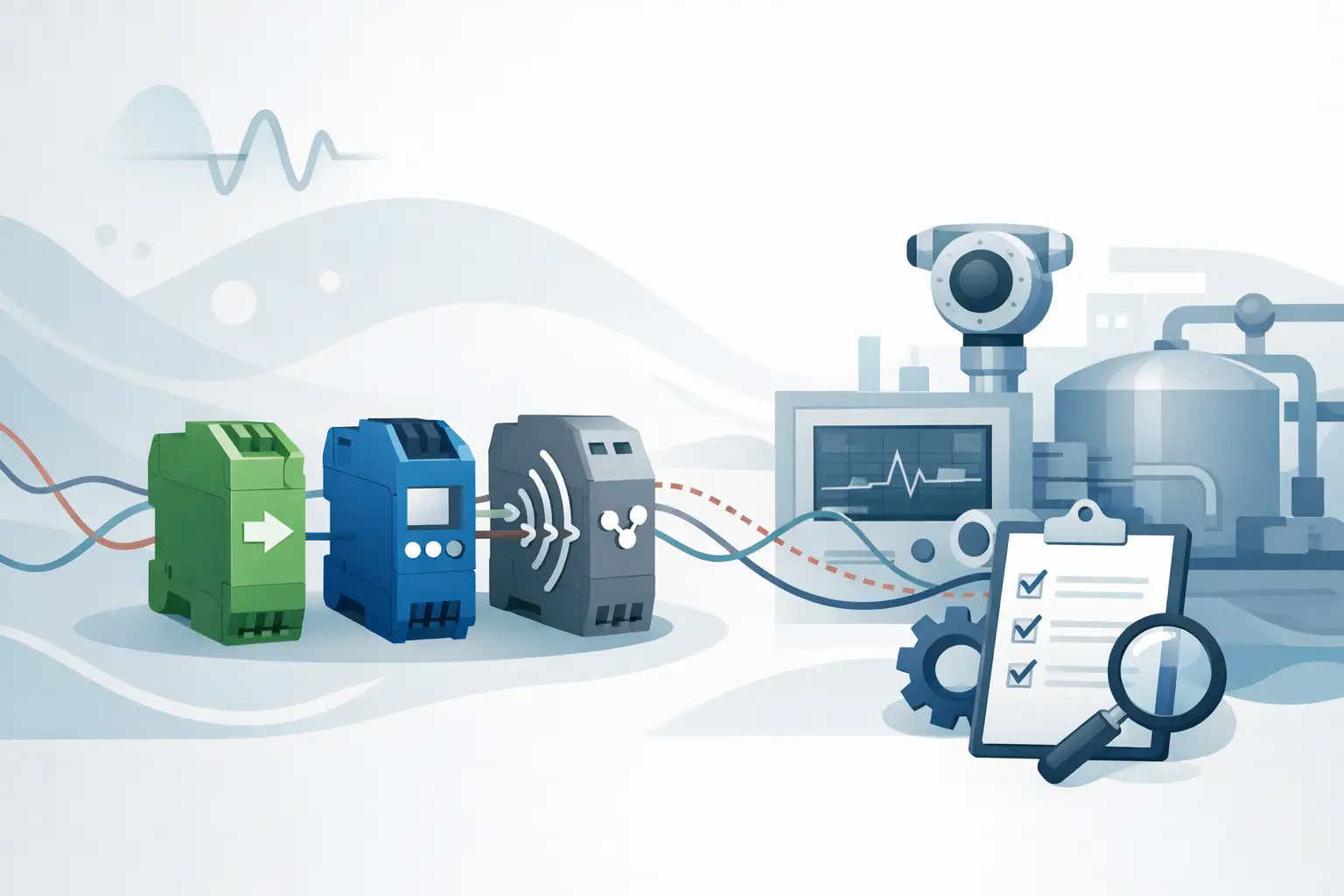
HART Signal Isolator Selection Guide
A loop that calibrates cleanly on the bench can still fail in the field when grounding issues, hazardous-area constraints, and HART communication are all present at once. That is why HART signal isolator selection deserves more than a quick check of voltage and current range. In process plants, the wrong isolator can block digital communication, compromise diagnostic visibility, or create approval gaps that become costly during commissioning or audit.
Why HART signal isolator selection is different
A standard analog isolator and a HART-capable isolator may look similar on a datasheet, but they are not interchangeable. HART rides on the 4-20 mA analog signal as a digital FSK signal. If the isolator does not pass that digital component correctly, the control loop may still show process value while handheld communicators, multiplexers, and asset management systems lose access to device data.
That difference matters most in plants that rely on remote diagnostics, proof-test support, and device status monitoring. A transmitter that appears healthy at the analog level can still report internal alerts, sensor drift, or configuration changes through HART. If those diagnostics do not make it through the isolation layer, maintenance teams lose early warning capability and end up troubleshooting later under less favorable conditions.
In hazardous-area applications, the decision becomes even more specific. The isolator may also be part of the protection concept, not just a signal-conditioning accessory. That means selection has to align with area classification, intrinsic safety requirements, entity parameters, installation practice, and system documentation.
Start with the actual loop architecture
Good selection starts with the loop, not the catalog. Identify whether the application is point-to-point transmitter to DCS, output from a smart positioner, HART pass-through to a safety system, or connection into a multiplexer or asset management layer. The same product will not suit all four cases.
Powering arrangement is the first checkpoint. Some loops use a passive field device and require isolated powering from the interface. Others already have loop power available from the control side. If this is missed, the chosen isolator may not provide enough voltage headroom once cable resistance, input burden, and field device operating voltage are added together.
Then verify where HART communication needs to be visible. In some projects, HART only needs to work locally with a communicator across test points. In others, it must pass continuously to a HART multiplexer or control system input card. Those are different requirements. A product described as HART compatible may support local modem access but not full transparency across the entire channel in every operating condition.
What to check in a HART-capable isolator
The first requirement is HART transparency. That means the isolator must pass the digital HART signal without distorting or attenuating it to the point that communication becomes unstable. This sounds simple, but it is where many selection errors begin. Some devices support the analog loop correctly but have limited HART performance under certain load conditions or wiring arrangements.
Isolation strength is next. In noisy industrial environments, galvanic isolation protects the control system from ground potential differences, common-mode noise, and fault propagation. In plants with long cable runs, multiple earthing points, and variable-speed drives nearby, this is not optional. Stable communication depends on signal integrity, and signal integrity depends heavily on proper isolation design.
Power budget should be checked with discipline. A smart transmitter, especially one in a hazardous area, may need a minimum voltage at its terminals to operate correctly while also sustaining HART communication. If the isolator introduces too much voltage drop, the loop can become marginal. Marginal loops are difficult to diagnose because they may work during startup and fail later during temperature shifts, maintenance intervention, or handheld connection.
Input-output behavior also matters. Determine whether the application needs transparent 4-20 mA transfer, signal conversion, split output, or repeating functionality. Some isolators are designed to duplicate a signal to multiple systems while preserving isolation. Others are intended only for simple single-channel transfer. If the design includes both control and monitoring paths, that distinction becomes important.
Hazardous-area approvals are not a box-ticking exercise
For hazardous locations, HART signal isolator selection must be tied directly to the protection method and installation zone. ATEX and IECEx certification, where required by the project or regional specification, should match the actual application rather than simply appear on the front page of a brochure. Review entity or FISCO-related parameters, permissible field device connection details, and mounting requirements.
This is especially important when the isolator is acting as an intrinsically safe interface between the safe area and the hazardous area. The approval must cover the intended field device type, cable characteristics, and loop arrangement. A mismatch may not show up until documentation review, FAT, or site acceptance, and by then the delay affects panel completion and startup.
In higher-integrity applications, safety lifecycle considerations also come into play. If the signal is associated with shutdown logic, burner management, or another risk-reduction function, the isolator may need to align with SIL-related system requirements. That does not mean every HART isolator must be safety certified, but it does mean the selection should reflect the actual function of the loop within the broader architecture.
Compatibility with control systems and field devices
Not all DCS, PLC, and asset management platforms handle HART in the same way. Some analog input cards ignore the digital layer entirely. Some support HART pass-through only on selected channels. Some require specific load conditions or modem access points for stable communication. The isolator should be selected with the final host architecture in mind, not just the field device.
Field-side compatibility is equally important. Smart pressure transmitters, temperature transmitters, valve positioners, and level instruments can have different current draw, startup behavior, and HART communication characteristics. If the application includes multidrop HART, specialty positioners, or legacy devices, confirm support before standardizing the interface.
This is where engineering support adds real value. A serious supplier should be able to review the exact control card, field device, hazardous-area classification, and required communication path before recommending a part number. That approach reduces rework and protects startup schedules.
Environmental and installation factors that affect performance
Panel space, ambient temperature, vibration, and wiring density can all influence isolator performance over time. A compact DIN-rail design may look efficient, but if thermal derating is ignored in a densely packed marshalling cabinet, the result can be reduced reliability. In offshore, chemical, marine, and other harsh settings, long-term stability matters as much as initial functionality.
Terminal accessibility is another practical issue. Maintenance teams need to test loops, verify communication, and replace modules without disturbing adjacent wiring more than necessary. If a product supports diagnostics, fault indication, or easier loop verification, that can reduce mean time to repair during outages.
Electromagnetic conditions should also be considered. HART communication is resilient when the loop is properly designed, but poor shielding, grounding errors, and heavy electrical noise can still create intermittent problems. The isolator should be viewed as one part of the signal integrity strategy, not the entire solution.
Common mistakes in HART signal isolator selection
The most common mistake is assuming any isolator labeled for 4-20 mA will support HART communication. The second is selecting based only on nominal loop current and overlooking voltage headroom. The third is treating hazardous-area approval as generic instead of application-specific.
Another frequent issue is forgetting the full communication path. Engineers may validate the transmitter and the host but not the handheld communicator, multiplexer, or maintenance modem connection. The loop then passes process value but fails when diagnostics are needed most.
There is also a procurement-driven mistake that appears late in projects: replacing a specified HART-transparent isolator with a lower-cost analog equivalent. On paper, both may appear to satisfy the current loop requirement. In operation, one supports device intelligence and one blocks it.
A disciplined selection approach
A practical approach is to define five points before choosing the device: loop power method, HART access requirement, hazardous-area classification, host system compatibility, and required certifications. Once those are fixed, compare electrical performance, approval details, mounting constraints, and maintenance practicality.
For high-risk industries, product selection should always support documentation quality as well as electrical function. Clear certification records, installation parameters, and traceable technical data reduce friction during design review and compliance checks. That is particularly relevant for operators managing Ex applications, shutdown systems, and audit-heavy process environments.
Arya Automation works in exactly these conditions, where signal isolation is not an accessory but part of dependable plant design. The best choice is usually not the most feature-heavy unit. It is the isolator that preserves HART communication, meets the hazardous-area requirement, fits the control architecture, and keeps the loop stable through real operating conditions.
When you select with the full application in view, the isolator disappears into the background as it should. That is a good result in any critical plant: no communication surprises, no approval conflicts, and no lost time when the process needs answers fast.