


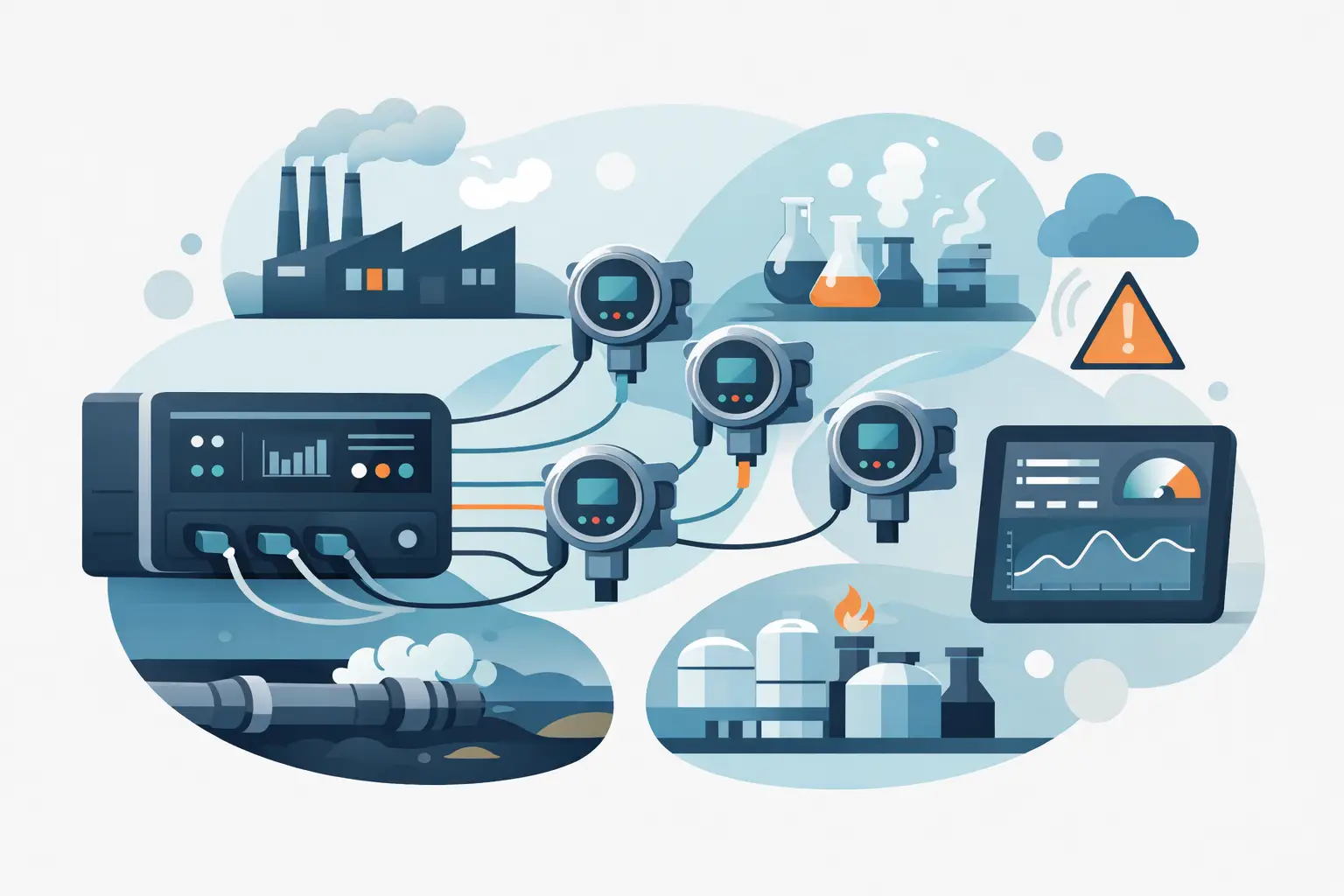
Multiplexer Systems for Gas Detection
A ten-point gas monitoring requirement can become a twenty-cable problem very quickly. In refineries, chemical plants, tank farms, and other hazardous process environments, the question is rarely whether gas detection is needed. The real question is how to monitor multiple points efficiently without compromising response time, certification requirements, or maintenance access. That is where multiplexer systems for gas detection become a practical engineering choice.
These systems are used to collect gas samples from several locations and route them, in sequence, to a single analyzer or detector. Instead of installing a dedicated analyzer at every sampling point, a multiplexer allows one instrument to monitor multiple zones through controlled switching. For plants managing cost, panel space, and system complexity, that architecture can be highly effective. For plants managing fast-changing hazards, the design has to be handled with discipline.
What multiplexer systems for gas detection actually do
At a functional level, a gas detection multiplexer selects one sampling line at a time and directs that sample to the connected detection device. The system usually includes solenoid valves or other switching elements, tubing, flow control, filtration, a control interface, and status indication. In more advanced configurations, it may also include alarms for line blockage, pump failure, low flow, or valve fault.
This approach is common in aspirated gas detection applications where air or process gas is drawn from remote sampling points back to a central cabinet. It is particularly useful when the analyzer is expensive, highly specialized, or intended for trace-level measurement that would be impractical to duplicate across many points.
The engineering appeal is clear. One analyzer can cover multiple sampling positions, central maintenance becomes easier, and the overall system can be contained in a certified and serviceable enclosure. But the performance of the whole arrangement depends on more than valve count. Sample transport time, purge cycles, and line integrity all affect whether the reading is actionable.
Where these systems fit best
Multiplexer architecture is not a universal answer for every gas hazard. It fits best where detection points are distributed, the gas source is relatively stable or slow-moving, and centralized analytics provide a better outcome than multiple local transmitters.
Typical applications include tank storage areas, analyzer shelters, process skids, battery rooms, hydrogen systems, semiconductor or specialty gas installations, and enclosed industrial spaces where several zones must be sampled. It is also relevant where environmental conditions are harsh and keeping the sensitive measuring equipment in a protected control room or analyzer cabinet is preferable.
In these environments, the system can reduce installed hardware in the field and simplify calibration planning. Instead of servicing a large number of individual detector heads, maintenance teams can focus on one high-value analyzer and verify the sampling network around it.
That said, if the risk scenario demands immediate point-level response, a fixed detector at each location is often the better choice. A multiplexer cycles through channels. It does not observe all points at the exact same moment.
The main engineering trade-off
The strongest advantage of a multiplexer is efficiency. The main compromise is time.
Because the system samples sequentially, each location waits its turn. If the scan time is too long, a transient leak could develop and escalate before the analyzer reaches that line. This is why the design process has to start with hazard analysis, not hardware preference. You need to understand the gas type, release behavior, room volume, ventilation rate, required alarm response, and the consequence of delayed detection.
For toxic gas monitoring in low-flow, enclosed zones, a well-designed aspirated multiplexer may perform very well. For combustible gas release in an area with rapid dispersion or ignition risk, the acceptable delay may be much smaller. In that case, the plant may need continuous fixed-point detection, or a hybrid arrangement that combines local detectors with multiplexed sampling for secondary areas.
This is also where procurement decisions can go wrong. A lower detector count looks attractive on paper, but if channel dwell time, tubing length, and purge logic are not aligned with the process hazard, the savings are false economy.
Design factors that determine performance
Sample line length and transport delay
The longer the sampling tube, the longer it takes for gas from the monitored point to reach the analyzer. Tube diameter, pump capacity, gas properties, bends, filters, and ambient temperature all influence this delay. A system that appears acceptable in layout drawings can perform poorly if transport time is not calculated and validated.
Switching and purge logic
When the multiplexer changes from one channel to another, residual gas from the previous line can affect the new reading. Proper purge timing is essential. The analyzer must receive a representative sample from the active point, not a mixed or diluted transition sample. This is especially important when switching between zones with very different gas concentrations.
Material compatibility
Tubing, seals, valve bodies, and filters must be compatible with the target gas and the plant environment. Some gases adsorb onto certain materials, some are corrosive, and some require strict cleanliness to avoid contamination or false readings. Material selection is not a detail to leave until panel assembly.
Flow supervision and fault diagnostics
A blocked line, failed pump, sticking valve, or leaking fitting can create a dangerous false sense of security. For this reason, serious multiplexer systems include line monitoring and fault indication. If the system cannot confirm sample flow and switching integrity, the operator cannot fully trust the reading.
Certification and hazardous-area installation
If the sampling points, control hardware, or associated interfaces are in classified areas, the full installation has to match the site certification strategy. Depending on the design, this may involve intrinsically safe interfaces, Ex-certified enclosures, segregation requirements, and documented compliance with ATEX, IECEx, or project-specific standards. For many facilities, this is not optional paperwork. It is part of the risk control structure.
When a multiplexer is the right choice
A good multiplexer application usually has three characteristics. First, there are multiple sampling points but a limited need for simultaneous readings. Second, the analyzer is specialized or costly enough that duplication across all points is difficult to justify. Third, the detection objective supports sequential scanning once transport and dwell times are accounted for.
This makes the approach attractive for centralized toxic gas monitoring, sample extraction from process enclosures, and applications where maintenance access to many field-mounted detectors would be disruptive or expensive. In these cases, the system can improve maintainability while preserving analytical quality.
It can also help where environmental stress is high. Heat, washdown exposure, vibration, corrosive atmosphere, or difficult access can shorten field device life. Keeping the core analyzer in a protected panel while only the sampling network extends into the process area may offer better long-term reliability.
When it is not the right choice
There are also clear situations where multiplexing should be avoided. Fast-developing combustible gas risks, open-area leak scenarios with severe consequence, and safety functions requiring immediate localized alarm action are poor candidates for a sequential sampling strategy. A channel-based polling system introduces delay by design.
Plants should also be cautious when the sample network becomes too large or too complex. As the number of lines increases, so do the opportunities for leakage, contamination, response drift, and maintenance burden. Beyond a certain point, a distributed architecture may be easier to validate and safer to operate.
This is why system selection should sit with engineering, operations, and safety together. Gas detection is not only an instrumentation decision. It is part of the protective layer strategy.
Specifying multiplexer systems for gas detection
When evaluating multiplexer systems for gas detection, buyers should look beyond the channel count and enclosure dimensions. The better questions are more operational. What is the verified response time at the farthest sampling point? How is line blockage detected? What purge logic is used between channels? What certifications apply to the installed configuration? How is failure reported to the PLC, DCS, or fire and gas system?
Integration matters as much as the hardware. Alarm handling, fault status, maintenance bypass, and event logging all need to fit the plant control philosophy. If the system is going into a regulated or hazardous process environment, documentation quality matters too. Drawings, loop details, certification records, and maintenance procedures should be available from the start.
For this reason, many operators prefer to work with suppliers that understand both the product and the application. Arya Automation, for example, operates in exactly this space – certified industrial safety and automation systems where hazardous-area compliance, reliability, and engineering support have to be treated as one package rather than separate tasks.
A better buying decision starts with the hazard
Multiplexing is neither a shortcut nor a default. It is a specific design response to a specific monitoring problem. Used correctly, it can reduce analyzer count, simplify maintenance, and bring multiple gas sampling points into a controlled and certifiable architecture. Used carelessly, it can introduce delay where speed matters most.
The right question is not whether a multiplexer can monitor ten points. The right question is whether those ten points can be monitored sequentially without weakening the safety function. Start there, and the rest of the specification becomes much clearer.