


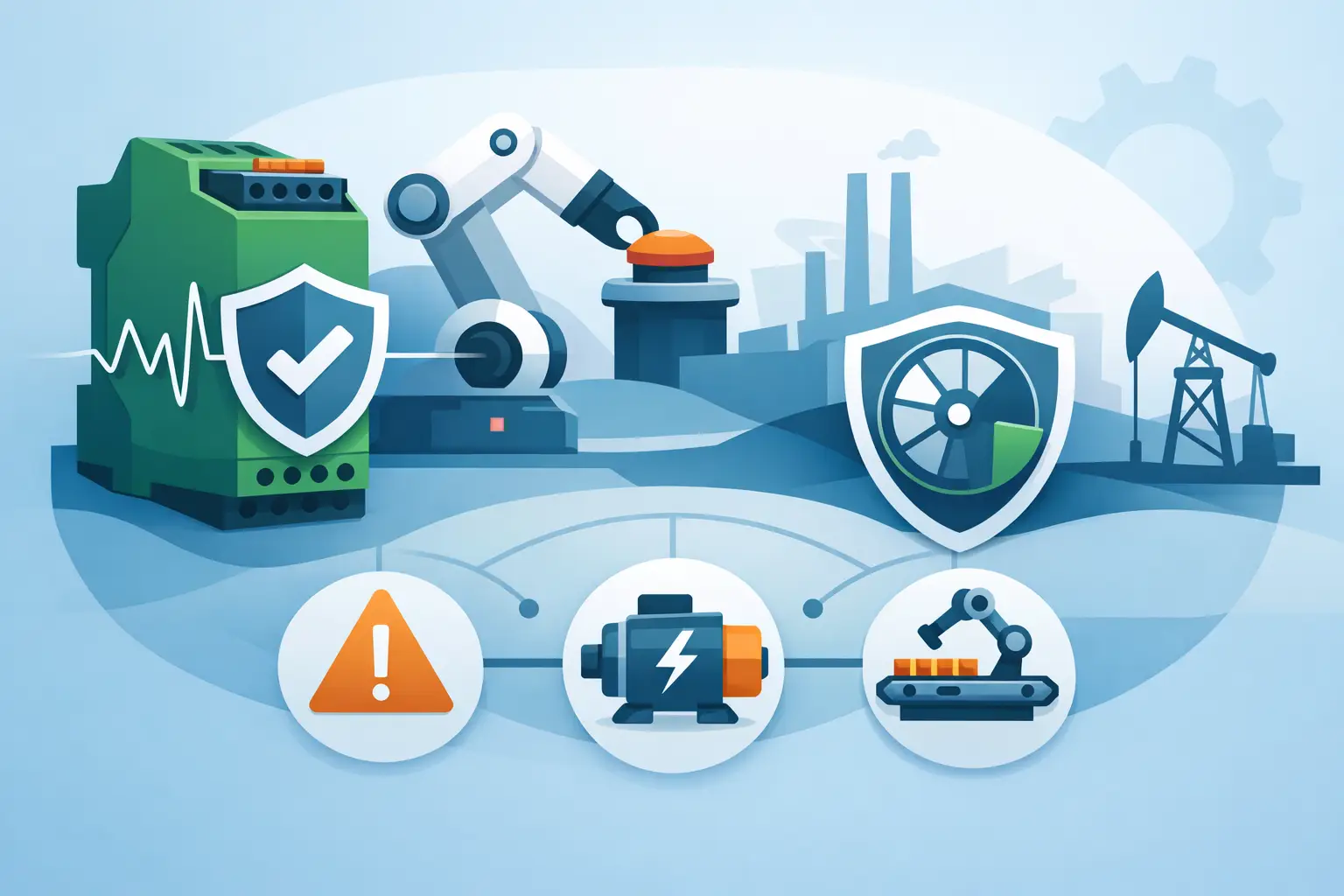
SIL2 Safety Relay Applications That Matter
A shutdown signal that arrives one second too late can mean a plant trip, equipment damage, or a serious personnel risk. That is why sil2 safety relay applications are not just a component-level choice. They are part of how engineers build dependable protection layers in process plants, OEM systems, and hazardous-area installations where failure tolerance is low.
In practice, a SIL2 safety relay sits between field conditions and a defined safe response. It monitors a critical input, evaluates fault conditions, and drives outputs into a known safe state when required. The value is not only in switching logic. It is in certified behavior, predictable diagnostics, and the ability to support a safety function that has been properly specified in the wider loop.
Where SIL2 safety relay applications fit best
The most common use case is simple to describe but demanding to execute – a process or machine must move to a safe state when a hazardous condition appears. In regulated industries, that can include emergency shutdown, burner management permissives, high-level trip action, overpressure shutdown, gas detection response, and rotating equipment protection.
In oil and gas and petrochemical plants, SIL2 relays are often used to process shutdown commands from pressure switches, temperature contacts, level alarms, manual emergency stop stations, or fire and gas systems. The relay then drives a final action such as de-energizing a solenoid valve, dropping a permissive, isolating a fuel source, or initiating a controlled shutdown sequence. The design priority is clear – fail-safe response under fault conditions, with documented performance that aligns with the target safety function.
In machinery and packaged systems, the same principle applies but with different constraints. OEMs may use SIL2 relays for safe stop functions, guard door monitoring, hydraulic power isolation, or interlocked restart prevention. Here, response time, reset philosophy, and diagnostic coverage matter as much as certification. A relay may be technically suitable on paper yet still be the wrong choice if the machine architecture requires more complex logic or networked safety diagnostics.
Typical industrial examples
Emergency shutdown systems are among the clearest SIL2 safety relay applications. A dedicated relay can evaluate one or more shutdown inputs and transfer outputs into a de-energized state when process limits are exceeded. In a compact skid, this may be the most practical way to implement a certified shutdown function without moving immediately to a full safety PLC architecture.
Burner and combustion-related systems also rely on certified relay logic where fuel isolation must occur on flame failure, pressure deviation, or unsafe startup conditions. The exact system design depends on the burner standard, plant risk assessment, and local code requirements, but the need for deterministic shutdown remains the same.
Tank farms and chemical dosing systems use SIL2 relays for overfill protection and transfer interlocks. If a level switch reaches the trip point, the relay can stop transfer pumps or close valves before overflow develops into a spill or ignition risk. In these cases, engineers often balance simplicity against proof-test requirements. A relay-based solution can be highly effective, but only if the testing strategy is realistic for the operating team.
Rotating equipment is another strong fit. Vibration switches, bearing temperature contacts, and overspeed trip inputs can all be routed through a SIL2 relay where a compressor, fan, or pump must shut down safely before mechanical failure escalates. This is especially relevant in environments where uptime matters but not at the expense of personnel safety or secondary damage.
Why engineers choose a relay instead of a safety PLC
Not every safety function needs programmable logic. For a single, well-defined trip action, a SIL2 safety relay can reduce design complexity, cabinet space, commissioning time, and validation effort. It gives engineers a fixed-function safety element with known behavior and fewer opportunities for programming error.
That said, the relay approach has limits. Once an application involves voting logic, multiple permissives, sequence handling, event recording, or future expansion, a safety PLC may be the better long-term platform. The decision is rarely about which technology is better in general. It depends on the safety requirement specification, the number of I/O points, the need for diagnostics, and the plant’s maintenance capability.
A disciplined design team usually asks a straightforward question early: does this safety function need simple certified switching, or does it need flexible certified logic? If the answer is the first one, a SIL2 relay often makes sense.
Design factors that affect performance
Certification is the starting point, not the whole answer. A relay with SIL2 capability only contributes properly to the loop when the surrounding design supports it. Input device quality, final element behavior, proof-test interval, common cause failures, and wiring practices all influence the achieved risk reduction.
This matters in hazardous-area projects in particular. If the relay is processing signals from Ex-certified field devices through isolators or barriers, the total architecture has to be checked carefully. Signal integrity, galvanic isolation, fault propagation, and safe-area versus hazardous-area mounting all need review. A certified relay cannot compensate for weak loop design or poor segregation in the cabinet.
Response strategy also deserves attention. Some applications require manual reset after trip. Others may permit automatic reset under tightly defined conditions. Choosing the wrong reset method can create either nuisance downtime or an unsafe restart risk. The right answer depends on the hazard analysis, not operator convenience alone.
Diagnostic visibility is another practical issue. Maintenance teams need to know whether a trip was process-driven, wiring-related, supply-related, or caused by an internal fault. Relays with clear status indication and testable behavior are easier to support in demanding plants. That lowers mean time to repair and helps preserve uptime without weakening the safety case.
SIL2 safety relay applications in hazardous areas
Hazardous-area installations add another layer of discipline. In sectors such as hydrogen, chemical processing, marine, and offshore oil and gas, the shutdown function may interact with intrinsically safe circuits, gas detection, flame monitoring, or certified operator interfaces. The relay is only one element in a protection chain that must align with ATEX or IECEx requirements where applicable, as well as the plant’s functional safety strategy.
A common example is gas detection response. When a detector reaches a configured alarm or trip threshold, the relay may trigger fan shutdown, damper closure, fuel isolation, or an area alarm output. The engineering challenge is not merely switching an output. It is ensuring that the detection path, relay action, and final element all support the required response time and failure behavior.
This is where a specialist automation partner adds value. Companies such as Arya Automation are typically involved not only in supplying the relay, but in aligning the certified components around it – isolators, surge protection, interface modules, sensors, and panel architecture – so the installed function performs as intended in real operating conditions.
Common mistakes in relay-based safety functions
One recurring problem is selecting a relay based on the SIL label alone. Engineers still need to verify contact ratings, load type, environmental limits, diagnostic features, and compatibility with the field architecture. A relay may carry the right certification and still be mismatched to a solenoid load, startup current, or ambient temperature profile.
Another issue is underestimating proof testing. Safety functions are not self-justifying once commissioned. If the proof-test interval assumed in the design is not realistic for the plant, the achieved safety integrity may drift away from the original assumption. Good design matches theory to maintenance reality.
There is also the temptation to overuse relays in applications that have already outgrown them. When multiple shutdown causes, bypass management, sequence logic, and plantwide diagnostics become central, a fixed relay approach can become cumbersome. Simplicity is an advantage until it starts forcing workarounds.
What to evaluate before specifying one
For most projects, specification comes down to five practical checks: the required safety function, the input and output architecture, hazardous-area constraints, proof-test strategy, and maintainability. If those five are clear, relay selection becomes much more disciplined.
Engineers should also look at lifecycle support. A component in a safety loop needs dependable documentation, certification records, and predictable availability. In critical industries, procurement is not just buying hardware. It is securing traceable performance over the life of the plant.
The strongest SIL2 safety relay applications are the ones where the function is clearly defined, the relay is matched to the loop, and the surrounding safety architecture is engineered with the same rigor as the component itself. When those conditions are met, a relay becomes more than a switching device. It becomes a reliable part of how a facility protects people, assets, and production continuity.
The best place to start is not with a catalog. It is with the actual hazard, the required safe state, and the level of certainty your plant needs when that trip signal finally arrives.