


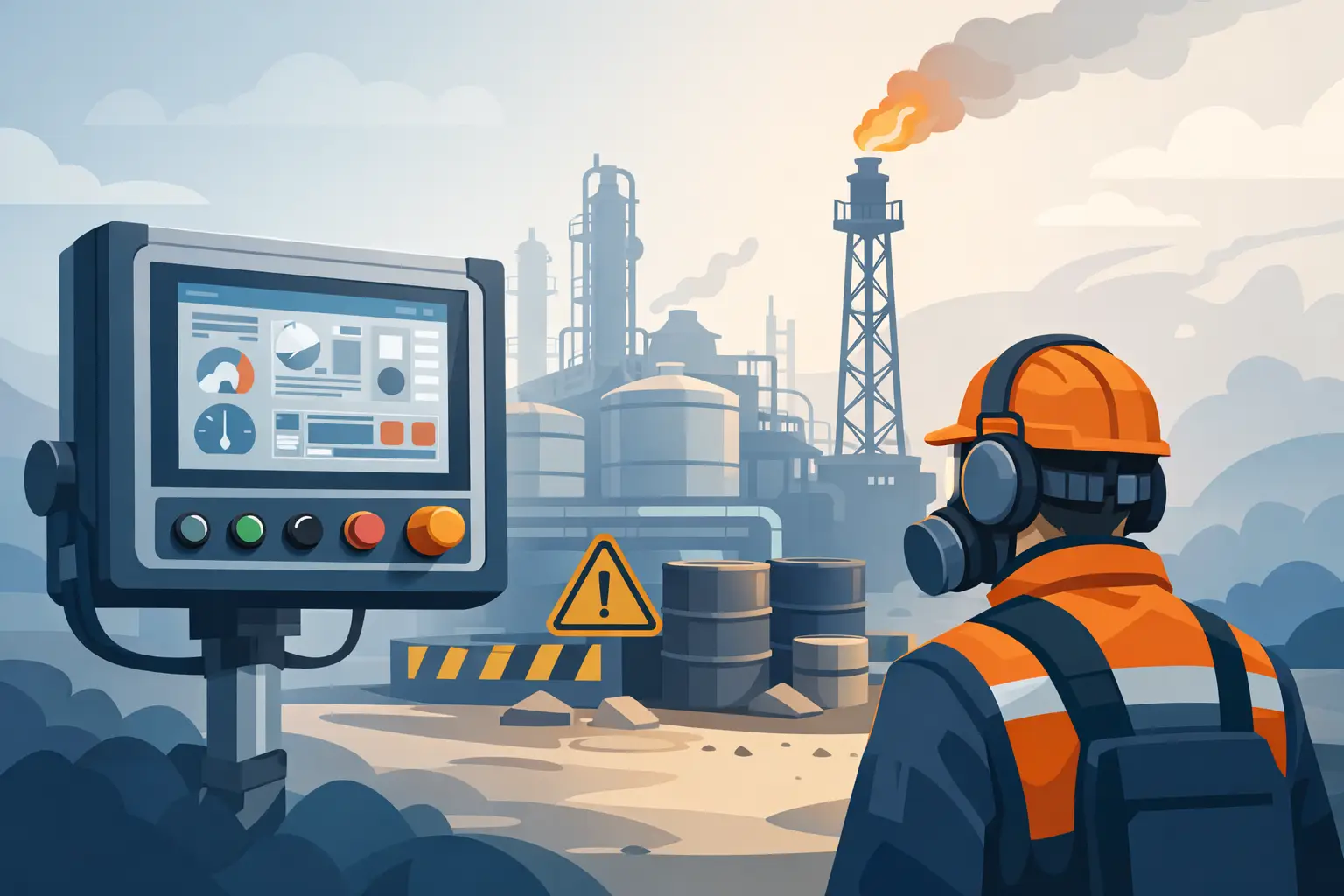
Operator Panels for Hazardous Areas
A touchscreen that works perfectly in a clean control room can become a liability the moment it is installed near flammable gas, combustible dust, or volatile vapors. In these environments, operator panels for hazardous areas are not just display devices. They are part of the protection concept, the operating philosophy, and the plant’s compliance position.
For plant engineers and automation teams, the selection process usually starts with a practical question: can operators safely view process data and issue commands from the field without introducing ignition risk or compromising uptime? The right answer depends on zone classification, certification requirements, enclosure design, power architecture, operator workflow, and integration with the wider control system.
What operator panels for hazardous areas actually need to do
In hazardous locations, an operator panel must do more than provide HMI functionality. It has to maintain safe operation under fault conditions, withstand the environmental demands of the site, and remain usable for the people who rely on it during routine operation, maintenance, and upset conditions.
That means the panel is evaluated on two levels at the same time. First, it must satisfy the user requirement – alarm visibility, process interaction, data access, local control, and often recipe or batch management. Second, it must satisfy the hazardous-area requirement – suitable protection method, correct marking, temperature classification, and compliance with the relevant installation standard.
This is where many specifications go wrong. A team may focus heavily on screen size, software platform, and communications, then treat the hazardous-area requirement as an enclosure add-on. In practice, the certification route affects the whole design. Intrinsic safety, purge and pressurization, flameproof construction, and increased safety do not create the same operating experience, maintenance burden, or lifecycle cost.
Hazardous area classification comes first
Before comparing panel options, the installation location must be defined clearly. Gas and vapor applications are typically classified by Zone 0, Zone 1, or Zone 2. Dust applications are classified by Zone 20, Zone 21, or Zone 22. In North American project frameworks, Class/Division may also shape requirements, even when equipment is sourced with ATEX or IECEx certifications.
The zone rating affects what type of panel can be used and how it is protected. A panel installed in Zone 1 will generally demand a more stringent protection approach than one installed in Zone 2. The same applies when moving from a non-hazardous control room to a field-mounted station near process equipment.
Temperature class is equally critical. Even a correctly certified operator panel can be unsuitable if its surface temperature exceeds the ignition temperature of the surrounding gas or dust atmosphere. This is not a paperwork detail. It is a design constraint that directly affects equipment choice, mounting conditions, and ambient temperature assumptions.
Protection concepts and their trade-offs
The most suitable hazardous-area operator panel often depends on which protection concept best fits the application.
Intrinsically safe designs limit available electrical energy so that ignition cannot occur, even under defined fault conditions. This approach is attractive where live maintenance and lower-risk field interaction are priorities. It can simplify some operational aspects, but display size, processing power, and peripheral options may be more limited than with conventional industrial HMIs.
Flameproof or explosion-proof panel assemblies contain any internal ignition within a certified enclosure. These can support more familiar industrial hardware, but they tend to be heavier, bulkier, and more demanding during installation and service. Accessing the enclosure for maintenance is not as simple as opening a standard cabinet door.
Purged and pressurized systems maintain a protective gas inside the enclosure to prevent hazardous atmosphere ingress. This can allow the use of standard or near-standard operator interface hardware in hazardous locations. The trade-off is system complexity. Purge control, gas supply quality, monitoring, and startup interlocks all become part of the risk and maintenance picture.
There is no universal best option. A compact intrinsically safe panel may be the right answer for operator acknowledgment and process visibility at a loading skid, while a larger purged HMI station may suit a process line that demands richer graphics and broader local interaction.
Certification is not a checkbox
When reviewing operator panels for hazardous areas, certification should be read as engineering data, not sales language. ATEX and IECEx markings need to align with the actual zone, gas group, dust group where relevant, ambient range, and installation method. If functional safety is part of the operator action path, the relationship between the HMI, logic solver, safety relays, and field devices also matters.
A common mistake is assuming that a certified enclosure automatically makes the full operator station compliant. In reality, every component that affects the protection method may need to be considered as part of the certified assembly. Cable glands, barriers, power supplies, interface devices, grounding arrangements, and even replacement parts can affect compliance.
Documentation matters as much as hardware. The certification file, installation instructions, control drawing, temperature data, and maintenance limitations should all be available before procurement is finalized. If that information is unclear, future inspection and audit activity becomes harder, and so does safe lifecycle support.
Human factors still matter in hazardous locations
A panel can be fully certified and still be poorly suited to the job. Operators in hazardous process areas may be wearing gloves, eye protection, flame-resistant clothing, or respiratory equipment. Visibility may be affected by glare, vibration, poor lighting, washdown, or weather exposure. A sleek interface designed for office-like conditions can fail quickly in actual production use.
Screen readability, touch response, button size, and alarm presentation should be assessed with the operating environment in mind. If an operator must step through multiple screens to isolate a pump trip or confirm a permissive, the panel may be adding delay at the wrong moment.
This is especially relevant in industries such as oil and gas, chemical processing, marine, and hydrogen applications, where local access to status and control can be valuable but must never introduce ambiguity. Good design reduces the number of actions required in the field and keeps critical information visible without unnecessary navigation.
Integration with the control architecture
An operator panel in a hazardous area rarely works alone. It usually sits within a broader automation structure that includes PLCs, DCS platforms, safety systems, signal isolators, surge protection, and communication networks. Compatibility should therefore be reviewed early.
Communication method is a key consideration. Ethernet-based connectivity may be preferred for data richness and diagnostics, but the physical installation in hazardous areas needs careful attention. Serial communications still have a role in some legacy or highly constrained systems. In all cases, the interface strategy should support both reliability and maintainability.
Power design also deserves more scrutiny than it often gets. If the panel depends on barriers, isolated power interfaces, or certified power-related solutions, those elements must be matched correctly. Voltage drop, fault behavior, and startup conditions can affect panel stability, especially in remote installations.
Cybersecurity is another practical issue. A field HMI that exposes unnecessary services or unmanaged remote access can create a different class of risk. In regulated plants, operational security and process safety increasingly overlap, so panel selection should support disciplined network segmentation and controlled access.
Environmental durability and lifecycle cost
Harsh-area performance is not only about explosion risk. Many hazardous installations also involve vibration, salt exposure, corrosive atmosphere, washdown, UV exposure, or temperature extremes. The panel must survive these conditions consistently, not just pass a bench test.
This is where enclosure material, sealing quality, display technology, and mounting design affect lifecycle value. Stainless steel construction may be necessary in corrosive or hygienic environments. Marine applications may prioritize resistance to salt and moisture ingress. Mining and heavy process sites may require more attention to shock and vibration.
The cheapest certified panel is often not the lowest-cost choice over time. If replacement intervals are short, spare parts are hard to source, or service access is complicated, maintenance costs rise quickly. Plants that run continuously usually benefit from equipment that is easier to inspect, support, and standardize across assets.
How to specify the right panel
A strong specification begins with the hazardous-area classification and operating task, then works outward to certification, interface needs, and lifecycle support. Instead of asking only for a panel that is “ATEX certified,” it is better to define the exact zone, gas or dust exposure, ambient range, enclosure constraints, communication requirement, and operator use case.
It also helps to separate what must happen locally from what can remain in the control room. Not every process function belongs on a field-mounted panel. In some applications, the safest design is limited local visibility with tightly controlled commands. In others, local intervention is necessary to reduce downtime and improve maintenance response.
Engineering support from suppliers with hazardous-area experience can make a measurable difference here. Companies such as Arya Automation operate in this space because the panel itself is only one part of a compliant and maintainable solution. Matching the HMI with certified interfaces, protection concepts, and installation practice is where many projects either gain reliability or create long-term problems.
The best operator panel is not the one with the most features. It is the one that fits the classified area, supports the operator under real site conditions, integrates cleanly with the control system, and remains compliant throughout its service life. In hazardous environments, that kind of fit is what protects both production and people.
When a panel will sit close to process risk, careful specification is not a delay to the project. It is part of building an installation that operators can trust every shift.