


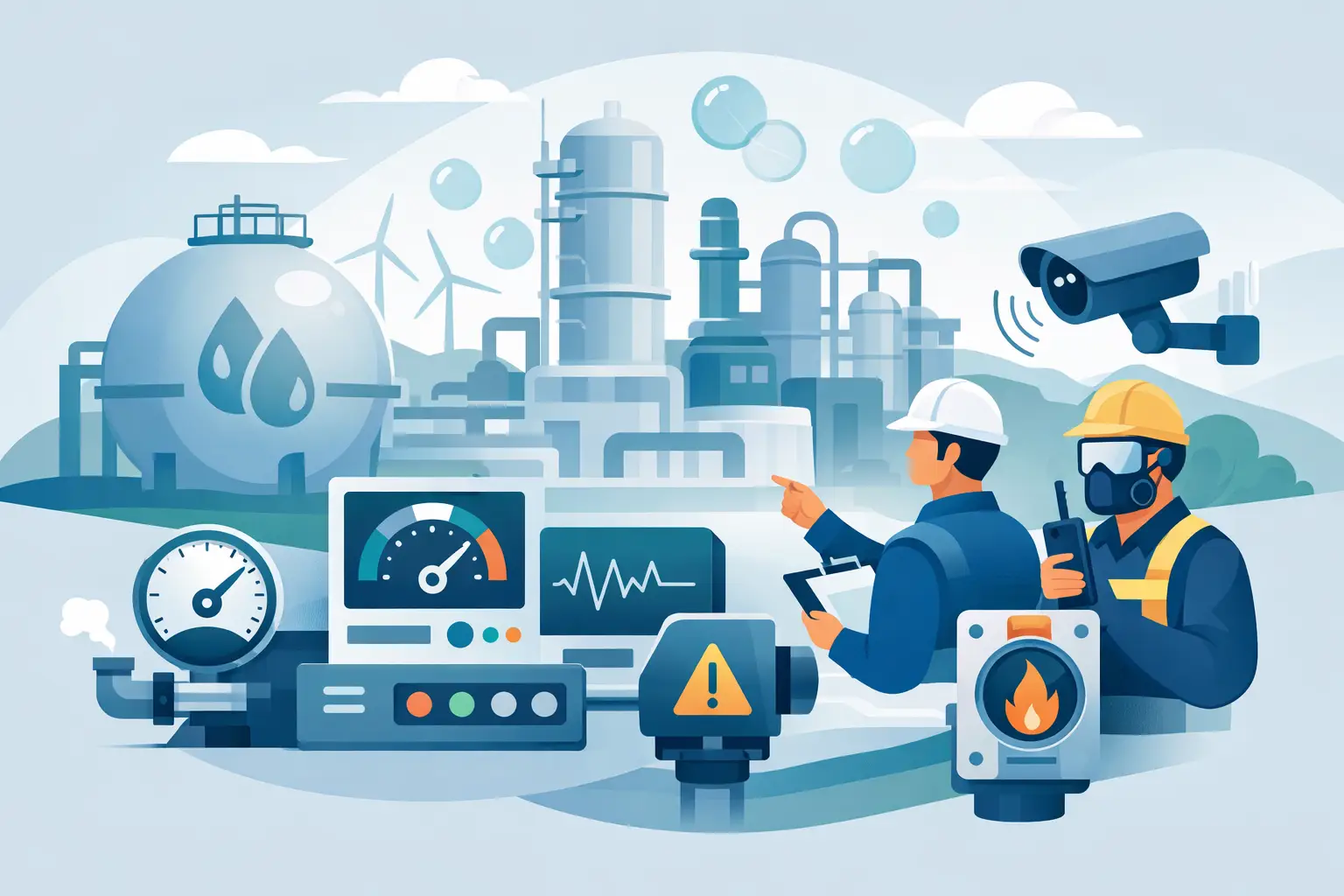
Hydrogen Plant Safety Instrumentation
Hydrogen does not give operators much time. It disperses quickly, ignites easily, and can escape through pathways that would be minor concerns in many other process plants. That is why hydrogen plant safety instrumentation cannot be treated as a standard add-on to general automation. In hydrogen production, compression, storage, and handling areas, instrumentation has to detect abnormal conditions early, transfer signals without compromising hazardous-area integrity, and support shutdown actions that are both fast and defensible under audit.
The challenge is not only the gas itself. Hydrogen facilities often combine high pressures, rotating equipment, electrolysis packages, reforming units, power conversion systems, and outdoor installations exposed to temperature swings, moisture, and electrical disturbance. Safety instrumentation has to perform accurately across all of it, while meeting ATEX, IECEx, and SIL requirements where applicable. For plant engineers and E&I teams, the real question is not whether to invest in better protection. It is how to build an instrumentation architecture that remains trustworthy when conditions are least forgiving.
What hydrogen plant safety instrumentation must do
At a practical level, hydrogen plant safety instrumentation serves three jobs at once. It has to detect hazardous conditions, preserve signal integrity, and trigger or support protective action. If any one of those layers is weak, the overall safety case starts to erode.
Detection begins with the process variables and event conditions most likely to signal loss of control. Hydrogen gas detection is the obvious one, but it is only part of the picture. Pressure, temperature, flow, flame presence, cabinet conditions, and equipment health all matter. In many plants, vibration monitoring on compressors, pumps, and balance-of-plant rotating assets becomes part of the safety conversation because mechanical degradation often shows up before a larger containment or process event.
Signal integrity matters just as much. In hydrogen environments, the distance between field devices and control infrastructure, exposure to surge events, and the need for intrinsic safety or galvanic isolation can all affect how trustworthy an instrument loop really is. A detector that senses correctly but delivers a distorted or unavailable signal during an abnormal event is not solving the problem.
Protective action is the final layer. This may involve safety relays, logic solving, alarm annunciation, valve closure, trip functions, or controlled isolation of sections of the process. In higher-risk applications, those functions need to be assigned and validated against a target safety integrity level rather than selected on convenience alone.
Certified design is not optional in hydrogen service
Hydrogen projects tend to expose a common mistake early: selecting instruments based on nominal function while treating certification as a paperwork exercise. In reality, hazardous-area approval and functional safety capability are part of the technical specification.
For areas with flammable gas risk, equipment may need ATEX or IECEx certification depending on the project and jurisdictional framework. That includes not just detectors but barriers, isolators, interface modules, operator devices, and power-related components installed in or connected to classified areas. The objective is straightforward – prevent the instrumentation layer from becoming an ignition source or a hidden reliability weakness.
Functional safety has a different purpose. SIL-rated relays, interfaces, and system elements are used where the risk assessment determines that a safety instrumented function is required. This is where hydrogen plant safety instrumentation moves beyond component selection and into engineered performance. The issue is not whether a relay can switch. The issue is whether the whole loop can achieve the probability of failure on demand expected by the safety requirement specification.
There is always a trade-off here. Overengineering every loop to the highest rating increases cost and complexity without necessarily improving real risk reduction. Underengineering a critical function creates exposure that will surface during hazard review, validation, or worst of all, operation. Good design starts with consequence, demand rate, and environment, then matches certified components to the actual duty.
The field layer: sensors, detectors, and equipment condition signals
Most discussions start and end with gas detectors, but hydrogen plants need broader field visibility than that. Gas detection should be positioned based on release behavior, ventilation patterns, congestion, and equipment arrangement. Hydrogen rises quickly, so detector placement often differs from hydrocarbon gas strategies. Enclosed skids, electrolyzer buildings, valve manifolds, compressor shelters, and roof spaces can all require different approaches.
Pressure and temperature instruments provide early warning of process deviation, especially around compression, storage, purification, and feed systems. Fast response is valuable, but stability and compatibility matter too. Instruments exposed to cycling, vibration, or contaminated service need to hold calibration and maintain output quality under stress.
Rotating assets deserve special attention. Compressors and pumps in hydrogen duty can create a chain of risk if bearing wear, imbalance, or looseness goes undetected. Vibration sensors are often thought of as maintenance tools, but in critical service they also support safer operation by identifying machinery deterioration before it becomes a containment or trip issue. That is particularly relevant where downtime and restart conditions carry their own process hazards.
Safe signal transfer is where many systems succeed or fail
A hydrogen plant may have quality field devices and still suffer from poor instrumentation performance if signal transfer is handled casually. Intrinsically safe isolators, signal converters, HART interfaces, and multiplexing systems are not secondary accessories. They are what preserve measurement availability and hazardous-area compliance between the field and the control or safety system.
Galvanic isolation can be essential for preventing ground loop issues and maintaining stable analog signals across distributed installations. HART-capable isolation and conversion also become valuable when teams need both the primary process signal and the device diagnostics without compromising safety or introducing noise into the loop.
In larger plants, marshaling and cabinet design can become crowded quickly. Multiplexer systems and disciplined interface design help reduce panel complexity, but only if they are selected with maintainability and certification in mind. Space saving alone is not a strong enough reason to adopt a given architecture. The better standard is whether the arrangement improves fault visibility, testing access, and long-term reliability.
Shutdown logic and operator response
Detection without decisive action is only half a safety function. Hydrogen facilities typically rely on layered response, starting with alarm management and escalating to automatic isolation or trip action where required. Safety relays and related interface hardware need to be chosen for their application fit, proof test practicality, and compatibility with the broader control philosophy.
This is where disciplined separation matters. Basic process control, alarm indication, and safety instrumented functions should not blur into one another just because the same skid builder or integrator packaged them together. Independent behavior, clear cause-and-effect logic, and verifiable fail-safe states are central to a credible design.
Operator interface also matters more than many projects admit. During an upset, ambiguous status indication or poor alarm prioritization slows response. Hazardous-area operator panels and indication devices should present the right information clearly, especially in packaged hydrogen systems where local intervention may be required during startup, shutdown, or maintenance.
Electrical protection in exposed and high-risk installations
Hydrogen plants often include outdoor equipment, long cable runs, power conversion equipment, and distributed skids. That creates exposure to surge events and electrical disturbances that can impair instrumentation exactly when availability matters most. Surge protection devices should therefore be treated as part of instrumentation reliability, not a separate electrical afterthought.
The same applies to power-related protection in hazardous and non-hazardous sections of the plant. Ex-proof power solutions, segregated supplies, and appropriate protection coordination help prevent nuisance failures and preserve the integrity of safety-related circuits. In practice, many instrumentation problems are rooted less in the sensor than in what happens to the signal and power path around it.
Engineering choices that improve long-term performance
The best hydrogen plant safety instrumentation strategy usually looks conservative on paper. It favors certified components, clear loop segregation, maintainable cabinet design, and practical test access over clever shortcuts. That approach tends to age better because hydrogen facilities are rarely static. Capacity expands, skids are added, and operating profiles change.
For that reason, plant teams should evaluate instrumentation not only for commissioning but for proof testing, calibration access, spares strategy, and fault diagnostics over years of service. A system that is hard to test will eventually be tested poorly. A system with weak diagnostics will keep maintenance teams guessing. Neither is acceptable in hydrogen duty.
Arya Automation’s approach to hazardous-area and safety-critical infrastructure reflects that reality. Certified isolators, SIL-capable relays, surge protection, vibration monitoring, and interface systems are most effective when they are engineered as one protection architecture rather than purchased as unrelated parts.
Hydrogen projects reward disciplined decisions early. When instrumentation is specified around certification, signal integrity, and response logic from the start, the plant is in a far better position to operate safely without sacrificing uptime.