


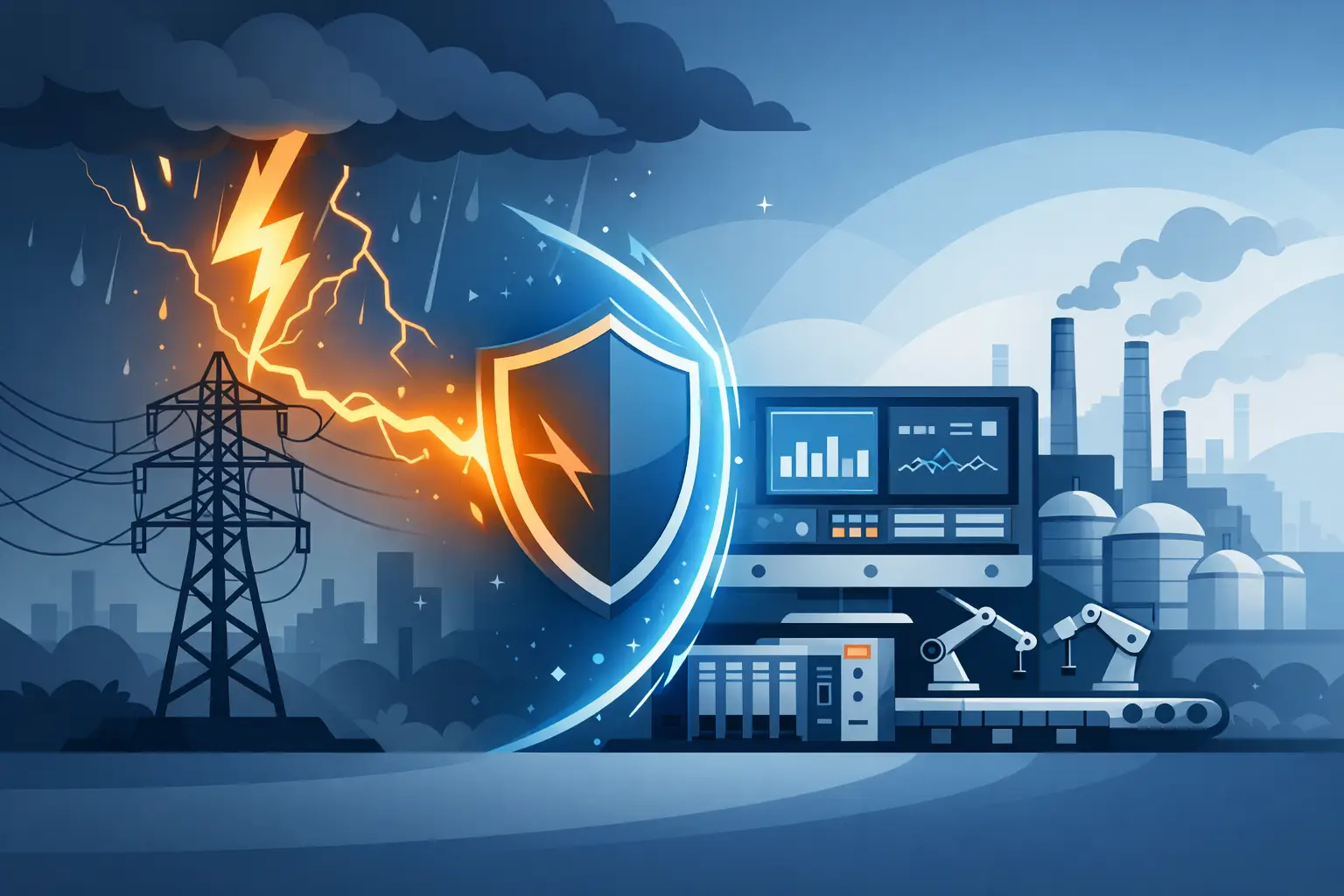
Surge Protection for Industrial Control Systems
A PLC rack that trips after a nearby lightning event rarely shows dramatic physical damage. More often, the symptoms look like nuisance faults, unstable analog values, failed communication cards, or an HMI that starts rebooting without warning. That is exactly why surge protection for industrial control systems deserves engineering attention early in design – and not only after the first unexplained outage.
In modern plants, control infrastructure is exposed from multiple directions at once. Field instruments sit on long cable runs. Panels are tied to utility power, UPS systems, VFDs, remote I/O, Ethernet switches, and serial networks. In hazardous or highly regulated processes, the cost of a surge event is not limited to one damaged component. It can affect process continuity, safety functions, traceability, and compliance.
Why surge events damage more than power supplies
Many teams still associate surge protection only with incoming AC power. That is too narrow for industrial automation. A damaging transient can enter through mains supply, 24 VDC power distribution, analog loops, RS-485 networks, Ethernet lines, and signals from field-mounted sensors.
The problem is magnified in large industrial sites where cables run between buildings, outdoor structures, skids, tank farms, and remote process units. A transient does not need a direct lightning strike to create trouble. Induced voltages from nearby strikes, switching operations, motor loads, capacitor banks, and grounding potential differences are often enough to stress electronics over time or destroy them in a single event.
Sensitive control electronics are particularly vulnerable because tolerances are tighter than in traditional electromechanical systems. PLC input cards, DCS marshalling, safety relays, HART interfaces, network switches, operator panels, and condition monitoring systems all rely on stable signal integrity. Even when a surge does not cause immediate failure, repeated overvoltage stress can shorten service life and create intermittent faults that are difficult to diagnose.
Surge protection for industrial control systems is a system design issue
Effective protection starts with a simple principle: protect every realistic entry path and coordinate devices across the installation. A single surge protective device at the main panel is not a complete strategy for a control system.
At the power level, the installation usually needs staged protection. The service entrance may require a high-energy device designed to divert large transient currents. Downstream control panels then need secondary protection matched to the panel distribution architecture and the sensitivity of connected electronics. Local protection at critical loads can further reduce residual voltage exposure.
At the signal level, the design has to match the circuit type. A 4-20 mA loop, a pulse input from a vibration sensor, an RTD signal, a HART communication line, and an industrial Ethernet segment do not have the same electrical behavior. The protection device must be selected for nominal voltage, bandwidth, line impedance, shielding scheme, and grounding method. If not, protection can interfere with normal operation, distort the signal, or create communication instability.
This is where many projects go wrong. Protection is treated as a catalog item instead of an engineered layer within the control architecture.
Where to install protection first
If budget or retrofit limitations require prioritization, start with the circuits that combine high exposure and high consequence. Outdoor instrumentation with long runs is a common first candidate, especially level transmitters, analyzers, weather stations, tank gauging devices, and vibration monitoring points on rotating equipment. Remote I/O nodes and communication gateways also deserve attention because one damaged node can affect multiple signals at once.
Critical panels should be reviewed next. That includes PLC and DCS cabinets, SIS interfaces, marshalling cabinets, fire and gas panels, telemetry systems, and any enclosure serving process shutdown logic or essential monitoring. Incoming power to these panels matters, but so do all incoming and outgoing copper signal paths.
Facilities in oil and gas, chemicals, marine, mining, hydrogen, and other exposed environments usually need a broader view. Outdoor assets, cable tray routing, structure bonding, and the interface between hazardous-area devices and safe-area cabinets all influence surge risk. In these installations, protection choices should align with the wider electrical and safety philosophy, not sit outside it.
Certification and suitability matter in regulated environments
In standard commercial buildings, a generic protective device may be acceptable for low-risk applications. In industrial process plants, that approach can create compliance and reliability problems.
Devices installed in or associated with hazardous-area systems must be suitable for the location and application. If a protection component is part of a certified loop or sits within an Ex-related architecture, engineers need to verify compatibility with ATEX or IECEx requirements where applicable, as well as any intrinsic safety parameters and installation rules. The same disciplined approach applies to safety-related systems, where poor component selection can compromise documentation, validation, or lifecycle management.
This does not mean every surge protective device carries the same certification burden. It means the complete installation has to be assessed properly. The closer the device is to a safety-critical or hazardous-area boundary, the more important suitability, documentation, and coordination become.
Grounding, bonding, and panel layout decide real-world performance
A high-quality surge protective device can still perform poorly if the installation is wrong. In practice, lead length, grounding path impedance, bonding quality, and cabinet layout have a major impact on clamping performance.
The connection to ground should be as short and direct as possible. Long, looping conductors increase inductive impedance during a transient event, which raises the voltage seen by the protected equipment. Panel builders should also avoid routing protected and unprotected conductors in ways that allow coupling inside the enclosure. Separation, shield termination discipline, and correct DIN-rail mounting practices all matter.
Grounding is where trade-offs appear. Some plants have legacy earthing systems, mixed vendor skids, or remote structures with imperfect equipotential bonding. In those cases, adding protection without reviewing grounding can move the problem rather than solve it. The right answer may involve bonding upgrades, revised cable entry practices, shield strategy changes, or isolation interfaces in addition to surge protection.
Common mistakes in surge protection for industrial control systems
The most common error is protecting AC power while leaving I/O and communication lines exposed. The second is selecting devices by voltage rating alone, without checking signal compatibility or surge current capacity. A third is assuming that because a device is installed, the system is protected.
Coordination is often overlooked. Upstream and downstream devices need to share energy in a predictable way. If they are poorly matched, one device can be overstressed while another remains underutilized. Maintenance teams also run into trouble when replacement parts are not equivalent to the original design or when inspection is ignored after known surge events.
Another avoidable mistake is treating all panels equally. Not every cabinet needs the same protection architecture. A local junction box for noncritical indication does not carry the same consequence profile as a SIS marshalling cabinet or a control panel for a hazardous process unit. Engineering effort should reflect operational risk.
How to evaluate a practical solution
A useful review starts with exposure mapping. Identify where transients can enter, which circuits are most sensitive, and what operational consequence follows a failure. Then check the existing grounding and bonding condition, panel topology, cable lengths, and network segmentation.
From there, device selection becomes more disciplined. Match power SPDs to the supply system and fault environment. Match signal protection to the exact loop or communication protocol. Verify short-circuit coordination, environmental ratings, mounting method, and any certification requirements tied to the application.
For demanding sites, it helps to work with suppliers that understand not only the protective component but also the control architecture around it. That matters even more where intrinsically safe barriers, isolators, SIL-related devices, Ex-proof power solutions, and high-availability process control all intersect. Arya Automation operates in that space, where surge protection is not an isolated accessory but part of a certified and reliable automation design.
The payoff is fewer invisible failures
Good surge protection rarely gets attention when everything is running well. Its value shows up as stable control signals, fewer unexplained card failures, stronger network availability, and less downtime after storms or switching events. For maintenance teams, that means fewer hours chasing intermittent faults. For operations and safety teams, it means greater confidence that the control layer will behave as designed when the process is under stress.
The right approach is not to add protective devices everywhere and hope for the best. It is to protect the paths that matter, coordinate the layers properly, and make sure the installation matches the electrical reality of the site. In industrial control systems, that discipline pays for itself long before the next surge event arrives.